
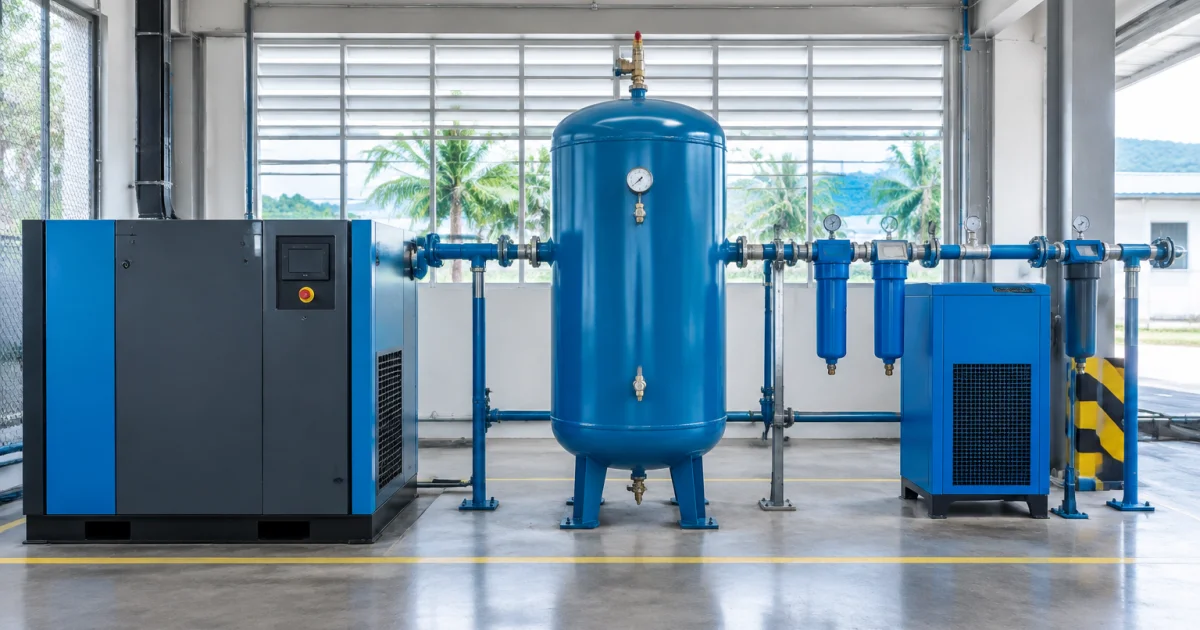

How to Size an Air Receiver Tank for Your Factory in Penang (Step-by-Step Method)
In many Penang factories, compressed air issues don’t start with the compressor—they start with unstable demand. Fast tool bursts, intermittent blow-offs, and short machine cycles create pressure swings, frequent load/unload events, and nuisance alarms. A correctly sized receiver tank is often the simplest way to buffer these short peaks.
This guide explains a practical method to size an Air Receiver Tank Penang applications commonly need: enough storage to ride through bursts, stabilise pressure, and reduce cycling—without wasting budget or floor space. It also covers how dryers, filters, and condensate handling affect real performance.
What an air receiver tank really does (and what it doesn’t)
An air receiver tank is a pressurised buffer installed between the compressor and the plant air network (or between stages of air treatment). Its main jobs are:
- Stabilise pressure during short bursts so downstream users see fewer dips.
- Reduce compressor cycling by preventing the compressor from reacting to every small demand change.
- Improve moisture separation by slowing airflow so condensate can drop out (with proper drains).
- Provide control response time, especially for fixed-speed rotary screw compressors using load/unload control.
What it doesn’t do: it won’t fix an undersized compressor, major leaks, or incorrect pressure settings. Treat the receiver as one part of the system—compressor, piping, dryer, filters, and drains all interact.
Before you calculate: collect these site inputs (10–20 minutes)
First-pass sizing can be done with estimates, but better inputs produce better results. Gather:
- Compressor type and control: fixed-speed load/unload, VSD, or multi-compressor sequencing.
- Compressor capacity: rated flow at your operating pressure (m³/h or CFM).
- Operating pressure range: upper setpoint and the lowest acceptable pressure at point of use.
- Peak event: tool bursts, baghouse pulses, pneumatic conveying, packaging cycles, etc.
- Peak duration: e.g., 2 s, 10 s, 30 s, 1 min.
- Available space: footprint/height, inspection access, clearance for safety valve and drain.
- Air treatment layout: filter and dryer location (e.g., Friulair refrigerated dryer) and whether you want wet/dry tanks.
- Condensate management: drain type and discharge routing (oil-water separator such as BEKO if required).
If you’re troubleshooting, also note symptoms like machine pressure fluctuation, frequent compressor starts, hot running, or moisture complaints.
Step-by-step sizing method (simple calculation + practical checks)
A practical on-site approach is event-based sizing: you need storage to supply extra air for T seconds while pressure drops from P1 to P2.
Step 1: Define your acceptable pressure band (P1 and P2)
- P1: receiver/header pressure at the start of the event (near normal header pressure).
- P2: minimum pressure before production is affected (tool performance drops, valves misfire, etc.).
Convert gauge pressure to absolute pressure for the calculation (bar(a) = bar(g) + 1). Stored air mass follows absolute pressure, so this conversion matters.
Step 2: Estimate the additional air required during the event (ΔQ)
Receiver storage covers the short-term deficit between demand and supply during the burst:
- If demand rises above what the compressor can deliver at that moment, the difference is ΔQ.
- If ΔQ is unknown, list devices that switch on together and use nameplate or typical consumption.
Example: if demand spikes to 2,500 L/min while the compressor delivers 1,700 L/min, then ΔQ = 800 L/min.
Step 3: Choose the burst duration (T)
Use realistic durations. Many dips come from short events (often 5–30 seconds). If the event lasts minutes, storage alone usually isn’t the answer—review compressor capacity, demand reduction, or leaks.
Step 4: Use the receiver sizing formula (convert to tank volume)
V = (ΔQ × T) ÷ (P1a − P2a)
- V = receiver volume
- ΔQ = deficit flow during the event
- T = event duration
- P1a, P2a = start/end pressures in absolute terms
To keep unit handling simple:
- Convert ΔQ to L/s (L/min ÷ 60).
- Convert pressures to bar(a) (bar(g) + 1).
Worked example (illustrative): A 20-second burst creates a 900 L/min deficit. Header starts at 7.5 bar(g) and must stay above 6.8 bar(g).
- ΔQ = 900 ÷ 60 = 15 L/s
- T = 20 s
- P1a = 7.5 + 1.0 = 8.5 bar(a)
- P2a = 6.8 + 1.0 = 7.8 bar(a)
- P1a − P2a = 0.7 bar
- V = (15 × 20) ÷ 0.7 ≈ 428 L
Round up to a standard size (e.g., 500 L), then validate with pressure logging. If the burst profile is uncertain, moving up one size step is often reasonable.
Step 5: Add a realism factor (and don’t forget leaks and restrictions)
The formula assumes receiver pressure equals what machines see. In practice, restrictions can cause a larger dip at the point of use. Before committing, check:
- Distribution piping: long runs, undersized pipe, and poor layouts increase transient pressure loss.
- Filter pressure drop: clogged or undersized filters add restriction (filtration lines such as Air Care must match flow).
- Dryer pressure loss: an undersized refrigerated dryer can add pressure drop and quality issues at high flow.
- Leaks: storage can’t compensate for continuous waste—fix leaks early.
If restrictions or burst demand are uncertain, adding ~10–30% buffer volume is a practical safeguard, then re-check after maintenance.
Where to place the receiver: wet tank, dry tank, or both?
Placement affects both pressure stability and moisture control.
Option A: Wet receiver before the dryer (buffering and water knock-out)
Upstream storage reduces peak flow into the refrigerated dryer and can improve moisture knock-out. This “wet tank” needs a reliable automatic drain and correct condensate routing; drain failures can send water downstream.
Option B: Dry receiver after the dryer (best for point-of-use stability)
Downstream storage holds treated air and stabilises pressure for moisture-sensitive or critical processes. If the bottleneck is upstream (e.g., dryer capacity or pressure drop), a tank only after the dryer may not address the root cause.
Option C: Two-tank approach (best control, more space)
A wet tank before the dryer plus a dry tank after is common where demand is highly variable. It buffers the compressor room while giving critical users stable, dry air—at the cost of more space and hardware.
Condensate, drains, and separators: don’t size a tank and ignore the water
Penang’s humid conditions make moisture management essential. Adding storage also adds places where condensate can form and collect.
- Automatic drain selection: use a reliable zero-loss or correctly set timed drain. Many Condensate Drain Penang issues come from neglected or incorrectly installed drains.
- Correct drain installation: drain at the lowest point with a proper drop leg and minimal restriction.
- Oil-water separation: compressor condensate often contains oil; separators (such as BEKO) support responsible discharge.
- Filtration and maintenance: high differential pressure indicates incorrect sizing or overdue service.
A receiver improves stability only if condensate is drained consistently and the air treatment train matches actual flow.
Validation in the real factory (quick tests before you commit)
After calculation, verify with simple checks—especially when upgrading an Industrial Air Compressor Penang installation or improving a compressor room.
1) Pressure logging at two points
- Main receiver/header in the compressor room
- A critical machine or the furthest production line
If the receiver stays stable but the machine drops, investigate distribution piping, regulators, or point-of-use filters.
2) Observe compressor control behaviour
For fixed-speed rotary screw compressors, excessive load/unload cycling can indicate insufficient storage, incorrect pressure settings, or an oversized compressor at low average demand. For VSD compressors, storage still helps by smoothing fast transients.
3) Check dryer and filter pressure drop under peak flow
During a known high-demand event, compare inlet vs outlet pressure across filters and the dryer. A receiver won’t overcome a major restriction; you may need resized components, maintenance, or parallel filtration.
4) Confirm space, safety, and maintenance access
Ensure clearances for safety valve and drain servicing, plus access for inspection. A slightly smaller tank that’s easy to maintain can outperform a larger tank installed awkwardly with neglected drains.
Practical sizing shortcuts (when you need a fast decision)
- Short tool bursts: size for a 5–30 second event using a pressure band your machines can tolerate.
- Frequent cycling on fixed-speed units: correctly sized storage is often a cost-effective first step.
- Adding new machines: size storage for the incremental burst deficit (ΔQ) rather than restarting from zero.
- Moisture complaints: verify dryer capacity (e.g., Friulair refrigerated dryer) and drain reliability before assuming a bigger tank will fix it.
After installation, confirm performance with pressure logging during real production cycles.
Conclusion: choose a tank size that matches your bursts, not just your compressor
To size an air receiver tank correctly, start with the event that causes pressure dips: define your acceptable pressure drop, estimate the short-term flow deficit, and calculate storage for that duration. Then sanity-check the result against real-world losses from piping, filters, dryer pressure drop, and condensate handling.
If you bring your compressor model, operating pressure band, and a description of peak events to a supplier, you can get a recommendation that considers the full system—receiver, air treatment, drains, and future expansion—so you achieve stable compressed air without unnecessary overspending.
Useful next reads
Frequently Asked Questions
How many litres should an air receiver tank be for a factory compressor system?
There isn’t one universal litre size. The most reliable approach is to size for your actual peak event: estimate the short-term flow deficit (ΔQ), decide how long the burst lasts (T), and allow pressure to fall only from P1 to a minimum P2 that your machines can tolerate. That calculation gives a practical receiver volume, which you then round up to the nearest standard tank size and validate with pressure logging.
Should I install the receiver tank before or after the refrigerated air dryer?
Both arrangements can work. A receiver before the dryer (wet tank) helps buffer peak flow and improves moisture knock-out, but it must have a reliable automatic drain. A receiver after the dryer (dry tank) stores already-treated air and can improve point-of-use stability for sensitive processes. Many industrial systems use a wet tank plus a dry tank when demand is highly variable.
Will a larger receiver tank reduce compressor cycling for a fixed-speed rotary screw compressor?
Often, yes. A correctly sized receiver provides stored air so the system pressure doesn’t change as quickly, which can reduce frequent load/unload cycling. However, cycling can also be caused by incorrect pressure settings, excessive leaks, or a compressor that is oversized for the average demand—so it’s best to check those factors at the same time.
Why is condensate draining critical when adding an air receiver tank in Penang?
A receiver tank creates a place for water to condense and collect. In a humid environment, if the automatic drain fails or is undersized, water can accumulate and carry over into the air network, causing corrosion, wet air at machines, and filter problems. Using a suitable drain strategy and managing discharge properly (often via an oil-water separator for compressor condensate) is part of a reliable installation.
Can Pneu-Care Resources Sdn Bhd help verify my receiver tank sizing and air treatment layout?
Yes. Pneu-Care Resources Sdn Bhd supports industrial compressed air systems by advising on receiver sizing, operating pressure bands, and installation layout, and can also supply related equipment such as rotary screw compressors, variable frequency screw compressors, Friulair refrigerated air dryers, Air Care filtration, and BEKO oil-water separators, along with servicing and temporary rental or loan units if needed.
Get a receiver tank size that matches your real production peaks
If your factory in Penang is seeing pressure dips, frequent load/unload cycling, or moisture issues, Pneu-Care Resources Sdn Bhd can help you confirm the right air receiver tank capacity using your operating pressure band and actual demand pattern. We supply air receiver tanks and support complete compressed air systems including rotary screw compressors, variable frequency screw compressors, Friulair refrigerated air dryers, Air Care filters, BEKO oil-water separators, and ongoing servicing—plus rental or loan units to keep you running during breakdowns or upgrades.