
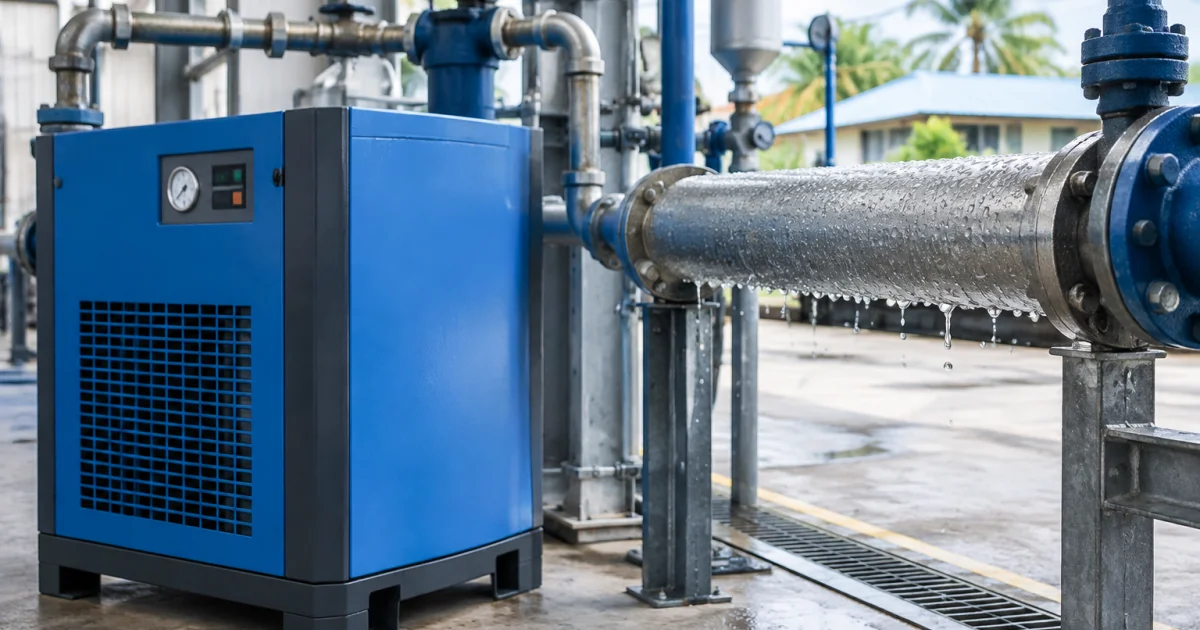

Stop Overpaying for Moisture Problems: Why Many Penang Plants Mis-Specify Compressed Air Dryers
Moisture in compressed air quietly drains money from a plant: corroded piping, sticking cylinders, damaged pneumatic tools, paint defects, wet instrument air, and constant drain “workarounds.” When complaints peak, teams often conclude, “We need a bigger dryer.”
That’s a common way to overpay. Many sites don’t have a “bad dryer”—they have a dryer that was specified as a standalone box instead of part of a system: compressor type, load profile, inlet temperature, pipe layout, filtration, drains, and even where dew point is measured.
If you’re comparing options for a Compressed Air Dryer Penang installation—or troubleshooting a dryer that never meets expectations—use the checks below to find where mis-specification usually happens and how to fix moisture without inflating your energy bill.
Why “moisture problems” get expensive fast (and why dryers get blamed)
Water is a natural by-product of compressing humid ambient air. After compression, air cools in aftercoolers, receivers, piping, and at points of use; as temperature drops, water condenses. A dryer’s role is to deliver predictable moisture content, typically expressed as pressure dew point.
Many plants see water at end points and assume the dryer is failing, when the cause is actually upstream or downstream. That misunderstanding creates avoidable costs:
- Oversized dryer purchases “to be safe,” even though inlet conditions are the real constraint.
- Higher pressure setpoints to mask wet tools/processes, increasing compressor power.
- Point-of-use add-ons that multiply maintenance and pressure drop.
- Premature filter changes when water/oil carryover destroys elements.
Dryers can fail—but often they’re being asked to solve a system problem they weren’t selected or installed to handle.
Mis-specification #1: selecting dew point targets by habit, not by application
A frequent mistake is choosing a dew point target because “that’s what we always use,” not because the application truly requires it.
Refrigerated dryers commonly suit general industrial air (tools, cylinders, blow-off, many instruments) by providing a stable, moderate dew point. Desiccant dryers are typically used when the process needs much drier air (for example, freezing risk or sensitive production requirements).
Overpaying happens when teams specify an ultra-low dew point “just in case,” while the real issue is liquid water carryover, poor drains, oil contamination, or high inlet temperature. Chasing a lower dew point can increase cost and complexity without addressing the root cause.
A practical way to set a dew point target
- List critical points of use (paint, packaging, lab equipment, instrument air, etc.).
- Define the failure mode (liquid water, corrosion, sticking valves, product defects, microbial growth).
- Check condensation risk (outdoor runs, air-conditioned spaces, cold surfaces).
- Choose the lowest dew point that solves the risk—not the lowest spec available.
A dryer isn’t an automatic “upgrade.” It’s a match between required air quality and real system conditions.
Mis-specification #2: using flow and pressure numbers that don’t reflect reality
Dryer sizing usually starts with flow and pressure, but few plants operate at one stable point. Many Penang sites have variable demand across shifts, product changeovers, and expansions. When sizing is based on a single “nameplate” or assumption, the dryer can be wrong in both directions.
- “Peak-only” sizing: buying for maximum possible flow even if peaks are brief—raising capital cost and reducing part-load efficiency.
- “Average-only” sizing: buying for typical flow and forgetting short peaks can push wet air downstream if buffering/control is inadequate.
What to measure before blaming the dryer
- Log compressor loading (load/unload cycles or VSD % load) over at least a normal week.
- Check pressure stability at the header and at the far end of distribution.
- Verify receiver capacity/placement (wet receiver before dryer, dry receiver after dryer often stabilizes conditions).
- Confirm changes since installation (new lines/machines, extended piping, added point-of-use devices).
A dryer sized to real operating data often costs less to purchase and runs more reliably than an oversized unit installed into a mismatched system.
Mis-specification #3: ignoring inlet temperature and real installation conditions
Dryers are rated at specific inlet conditions. In the field, inlet air is often hotter than assumed—especially with dirty aftercoolers, poor compressor-room ventilation, or heat recirculation.
Higher inlet temperature means more water vapor entering the dryer. A refrigerated dryer may struggle to reach design performance, and separators may pass more condensate. It can look like “the dryer is weak,” when the real problem is temperature control and separation upstream.
Installation checks that often fix dew point complaints
- Aftercooler performance: clean heat exchanger surfaces, adequate cooling airflow, working moisture separation.
- Compressor room airflow: prevent hot exhaust air from recirculating into the room.
- Correct pipe sizing/routing: excessive velocity increases pressure drop and can re-entrain condensate.
- Drain management: failed auto drains cause liquid carryover no dryer is designed to “absorb.”
Many replacement projects go wrong here: a new dryer is purchased to compensate for a cooling or drainage issue that would have been cheaper to correct.
Mis-specification #4: treating filtration as optional (oil carryover changes everything)
Moisture and contamination are linked. Oil carryover can coat heat exchangers, foul drains, reduce separation efficiency, and contaminate processes. Poor filtration can also make a correctly sized dryer appear underperforming.
That’s why “dryer-only” quotes can mislead. A reliable system typically needs the right compressed air filters in the correct sequence, sized for flow, acceptable pressure drop, and maintained on schedule.
If you’re evaluating an Air Dryers Supplier Penang, ask more than “What dew point can your dryer achieve?” Ask what filtration grades and layout they recommend for your application (utility air differs from paint, packaging, laboratories, and healthcare-related uses).
Pressure drop: the hidden monthly cost
Pressure drop across clogged filters, undersized piping, and poorly selected equipment pushes teams to raise compressor pressure. That increases energy use and can reduce reliability. Compare solutions by total pressure drop at your real operating flow—not just purchase price.
For context, Pneu-Care Resources Sdn Bhd supplies Air Care filtration solutions that are commonly specified alongside dryers to protect air quality and sustain performance.
Mis-specification #5: forgetting condensate handling and environmental housekeeping
Every compressor and dryer system produces condensate. If it isn’t drained and managed correctly, it becomes a reliability problem—and often a housekeeping problem around the utility area.
When condensate is treated as an afterthought, drains fail, water backs up, and liquid is pushed downstream again. A complete approach typically includes appropriate drains and, where relevant, oil-water separation for compressor condensate. Using a supplier who can cover dryers, filters, and condensate handling can reduce integration gaps and finger-pointing during troubleshooting.
So what should you do instead? A simple spec checklist that reduces overspending
Before approving a replacement or “upgrade,” use this checklist to reduce the risk of buying the wrong solution.
1) Define the problem precisely
- Where is moisture observed: dryer outlet, receiver, distant drops, or specific machines?
- What is it: liquid water, mist/fog, rust particles, oil/water emulsion?
- When does it happen: all day, only during peaks, rainy days, or night shifts?
2) Verify system inputs
- Actual flow profile (not just compressor nameplate).
- Operating pressure range and stability.
- Worst-case inlet temperature into the dryer.
3) Map the air treatment train
- Aftercooler + separator condition.
- Filter types, locations, and maintenance status.
- Receiver configuration (wet and dry storage).
- Auto drain operation and drain line routing.
4) Match dryer type to risk and operating pattern
- Refrigerated dryer for general utilities where moderate dew point is sufficient.
- Use targeted solutions if very dry air is only needed at specific points of use.
- Confirm part-load behavior and controls fit your demand variability.
5) Evaluate total cost, not just quoted unit price
- Pressure drop impact on compressor energy.
- Serviceability, spares availability, and maintenance plan.
- Risk reduction (scrap, rework, downtime) tied to your specific failure mode.
With this approach, dryer selection becomes an engineering decision—rather than a reaction to the latest wet-air complaint.
Related reading for Penang maintenance and engineering teams
- Air compressor rental options for continuity planning
- Services for compressed air systems and maintenance support
- Air Compressors Penang: brands and supplier considerations
Conclusion: stop buying “more dryer” and start buying the right system outcome
Moisture problems are expensive, but the costliest response is often an oversized or mismatched dryer purchased in a hurry. Many Penang plants mis-specify dryers by skipping basic verification: inlet temperature, load profile, pressure drop, filtration, drain health, and the dew point requirement at the application.
A dryer should be specified as part of a complete compressed air system. Done properly, you usually spend less overall by fixing root causes, avoiding unnecessary pressure increases, and reducing repeat maintenance and downstream damage.
If you’re comparing replacement options or want a second opinion, involve a supplier who will evaluate the whole setup—compressor, dryer, filters, and condensate handling—and recommend a configuration matched to how your plant actually operates.
Frequently Asked Questions
How do I know if my compressed air dryer is actually undersized?
Start by confirming where the moisture appears and under what conditions. If the air is dry at the dryer outlet but wet at far points, the issue is often distribution cooling, drains, or local pressure drops—not dryer capacity. If the air is wet immediately after the dryer during high-demand periods, then compare your real peak flow, inlet temperature, and operating pressure against the dryer’s rated conditions. An undersized unit is usually revealed by consistent dew point drift at the outlet during sustained peaks, not just occasional water at tools.
Is a refrigerated dryer enough for most factories in Penang?
For many general industrial uses (pneumatic tools, cylinders, blow-off air, and non-critical utility air), refrigerated dryers are commonly suitable when installed correctly with proper filtration and drains. However, if you have very dry air requirements for specific processes or risk of condensation at cold points, you may need a different approach (such as targeted point-of-use drying or a lower-dew-point solution). The right answer depends on the application, inlet conditions, and distribution layout.
Why do we still get water in the lines even though the dryer is running?
Common reasons include high inlet temperature into the dryer, failed or stuck auto drains, liquid carryover from a separator, incorrect bypass valve positions, insufficient receiver buffering, and poor filtration leading to fouled heat exchangers. Another frequent cause is condensation after the dryer: if air cools further in long piping runs, moisture can reappear downstream even when the dryer outlet is within spec.
What should I ask an air dryers supplier in Penang before buying a replacement?
Ask for a review based on your real operating data: peak and typical flow profile, header pressure range, measured inlet temperature to the dryer, required dew point at critical points of use, acceptable pressure drop, filter configuration, and condensate handling plan. A good Air Dryers Supplier Penang should be willing to discuss the full air treatment train (dryer + filters + drains + receivers), not just quote a unit size.
Do filters and oil-water separators really affect dryer performance?
Yes. Inadequate filtration can allow oil and contaminants to foul dryer heat exchangers and drains, reducing moisture separation and increasing pressure drop. Condensate handling also matters: if drains fail or condensate backs up, liquid water can be pushed downstream and look like a dryer problem. Oil-water separators don’t change dew point directly, but they support clean, consistent condensate management and better overall system housekeeping.
Need a second opinion on your dryer specification?
Pneu-Care Resources Sdn Bhd helps Penang plants troubleshoot moisture issues and specify air treatment correctly—so you don’t overpay for the wrong dryer. We supply Friulair refrigerated air dryers, Air Care compressed air filters, BEKO oil-water separators, and provide technical consultation, servicing, and temporary compressor support when uptime matters.
If you’re seeing dew point complaints, pressure drop, or water carryover, talk to our team for an application-based recommendation aligned to your real flow, temperature, and operating pattern.