
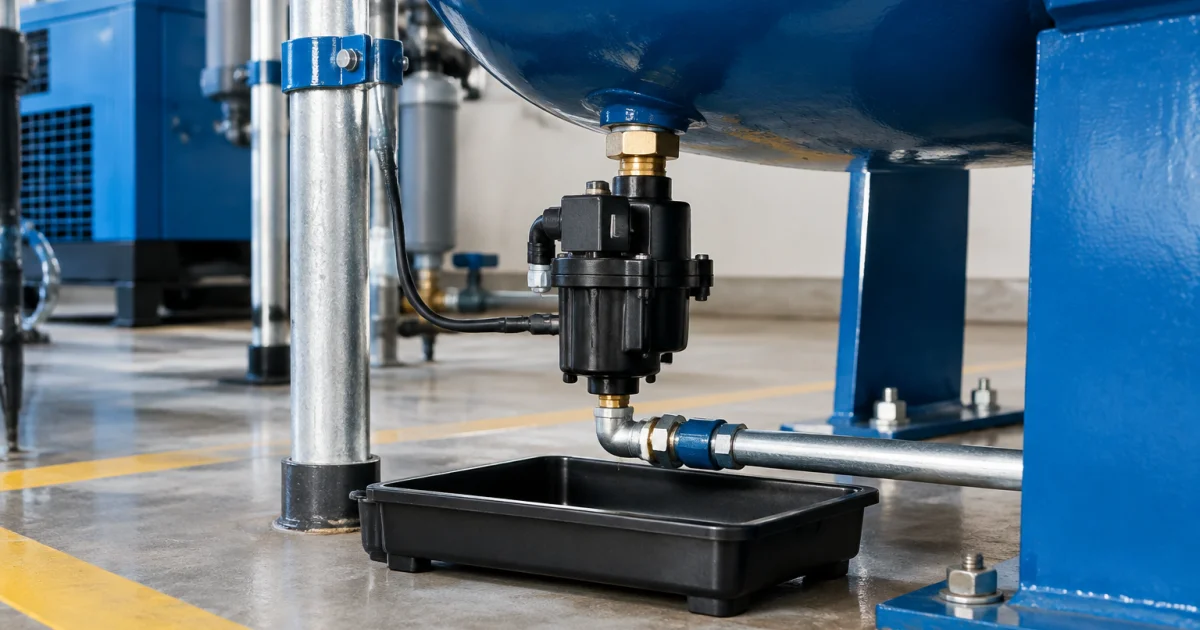

Penang Industry Update: Why Condensate Drains Fail in Humid Plants and How to Prevent Water Carryover
In Penang’s humid industrial environment, maintenance teams often see the same symptoms: water in air lines, wet filters, a “spitting” drain that won’t stop, or no draining at all. These issues are often blamed on the dryer or compressor, but a frequent root cause is simpler: condensate is not being removed consistently at each low point.
This industry update explains why a Condensate Drain Penang setup can fail in humid plants—and what to change in drain selection, outlet piping, and routine checks to prevent water carryover into tools, machines, and processes.
Why humid plants amplify drain problems (and why it shows up downstream)
Condensate forms when warm, moisture-laden air is compressed and then cools in aftercoolers, receiver tanks, dryers, and distribution piping. In high humidity, the water volume rises and forms faster, so marginal drainage that “mostly works” in drier conditions can fail quickly during load spikes.
Common condensate collection points include:
- Aftercoolers and moisture separators
- Compressor discharge lines and drop legs
- Air receiver tanks
- Pre-filters, coalescing filters, and activated carbon filters
- Refrigerated dryer separators and drain points
If any point cannot discharge properly, liquid can re-enter the air stream (“carryover”), overloading the next components and causing saturated filters, unstable dew point performance, corrosion, and water at point-of-use. Even a properly sized dryer cannot “fix” water that is continuously injected downstream by a flooded separator, receiver, or filter housing.
The most common reasons condensate drains fail in Penang facilities
Drain failure is rarely random. Most cases fall into a few repeatable patterns that can be confirmed quickly on the floor.
1) Incorrect drain type for the condensate load
Many plants still rely on timer drains. They can work, but they are unforgiving: wrong on/off settings lead to either flooding (under-draining) or wasted compressed air (over-draining). In humid plants, the “correct” timer setting can change by shift as demand and compressor loading vary.
- Under-draining: condensate builds in separators/filters and then slugs downstream.
- Over-draining: excessive air loss, noisy discharge, faster valve wear.
Demand-controlled/zero-loss drains can better handle varying condensate rates, but they still require correct installation and cleaning to avoid sticking or fouling.
2) Debris, rust, or oil sludge blocking the orifice
Corrosion scale, thread sealant fragments, and compressor oil aerosols can combine into sludge that blocks drain passages—especially in older systems or where filtration is weak. A partially blocked drain may “click” yet release little, leaving bowls/separators full after a cycle.
3) Poor piping practices at the drain outlet
A good drain can still fail if outlet piping creates backpressure. Typical causes include:
- Long, small-diameter discharge lines that restrict flow
- Upward routing that creates a trap the valve cannot push through
- Shared manifolds where one drain affects another
- Closed containers without venting
When the drain opens but the liquid cannot exit fast enough, condensate backs up into the separator/filter housing and is pushed downstream during airflow changes.
4) Float and sensor problems caused by contamination
Float mechanisms can stick when coated with oil/contaminants. Electronic level-sensing drains can also misread levels when exposed to dirty, oily condensate or particulate; heat cycling and vibration can loosen connectors over time. During troubleshooting, verify not only that the drain actuates, but that the upstream liquid level actually drops after discharge.
5) Missing drain points—condensate trapped where you don’t expect it
Sometimes the drain is fine—the piping layout is not. Plants often lack drains at true low points due to long headers without drip legs, sagging pipe, or new branches added without revisiting condensate management. When equipment or air demand changes, review the distribution network for new low points and add proper drain provisions.
How drain failure causes water carryover (a practical explanation)
- Condensate forms after compression and cooling.
- Condensate accumulates in separators, receivers, and filter bowls when drainage is inconsistent.
- Airflow velocity increases during demand peaks (tools cycling, machines starting, valves opening).
- Stored liquid is re-entrained as droplets/mist and carried downstream.
- Downstream components overload (filters saturate, dryer separators see higher load, point-of-use traps fill).
This is why technicians often see “random” water bursts: they typically align with airflow changes more than weather changes.
Two system elements strongly influence how visible carryover becomes:
- Air receiver volume and condition: receivers buffer flow changes, but a failed receiver drain turns the tank into a water reservoir that gets stirred during peaks. If you are specifying or troubleshooting an Air Receiver Tank Penang installation, treat drainage as part of the tank package.
- Dryer and filtration setup: a refrigerated dryer reduces moisture content but cannot remove repeated slugs of liquid water from upstream flooding. Coalescing filters protect air quality, but they can saturate quickly when hit by water.
Prevention checklist: selection, installation, and maintenance that actually works
Preventing repeat failures requires a system approach. The best drain will still struggle if it is installed at the wrong point or discharged into a restrictive outlet line.
1) Match drain type to operation, not just pipe size
Before choosing a drain, confirm:
- Is the compressor running 24/7 or cycling?
- Does demand fluctuate across shifts?
- Is the condensate oily/dirty or likely to include rust scale?
- Is air loss a major cost concern?
Timer drains can suit stable loads if set and maintained correctly. For variable loads, level-actuated drains typically reduce air loss while keeping separators/bowls empty. For reference on basic application and installation expectations, see Condensate Timer Drain.
2) Fix discharge piping to avoid backpressure
Keep discharge lines short, avoid routing upward, and avoid restrictive tubing where heavier condensate must pass. If condensate must be routed to treatment, use a properly sized manifold intended for condensate instead of improvised small lines that behave like traps. Where possible, keep the outlet visible or easy to inspect so restrictions are caught before they become carryover.
3) Add draining where the water really is
Physically walk the line to identify true low points and verify there is a drip leg and drain. Pay special attention to:
- Long horizontal headers
- Outdoor-to-indoor transitions that increase cooling
- Branches added after commissioning
- Points before sensitive equipment (instrument air, spray booths, lab equipment)
Many “compressor problems” are actually distribution problems: piping can act like a condenser if low points are not drained.
4) Coordinate drains with dryers and filters (don’t treat them separately)
Dryers and filters also depend on functional separators and drains. If those drains fail, moisture can appear downstream even when upstream drainage is adequate.
For persistent wet air, assess the full treatment train:
- Is the refrigerated dryer correctly sized and operating within expected conditions?
- Are pre-filters and after-filters correctly placed and maintained?
- Are drains installed and working at each separator stage?
If your facility is searching for Compressed Air Dryer Penang options due to water complaints, include a drain audit before replacing the dryer. For filtration that can reduce sludge reaching drain valves and seats, see Air Care Filter.
5) Treat and dispose of condensate properly
Condensate is often contaminated with compressor oil and solids. Proper handling reduces oily sludge buildup in discharge containers and lines and supports compliant disposal. Where oil is present, consider separation treatment such as a Beko Oil Water Separator.
6) Implement a realistic inspection routine (quick checks that catch failures early)
- Daily/shift: confirm key drains discharge and bowls/separators don’t remain full.
- Weekly: check for continuous blow (air loss), abnormal noise, or line vibration.
- Monthly: clean strainers (if fitted), inspect discharge lines for kinks/traps, and verify drain power/air supply as applicable.
If the same location keeps failing, treat it as a design signal: condensate load may exceed the drain type, contamination may be excessive, or the outlet routing may be creating backpressure.
When to escalate: signs the issue is bigger than the drain
Repeated drain failures can indicate broader system problems. Consider a compressed air assessment if you see:
- Multiple drains failing within a short period
- Unusual amounts of oil in collected condensate
- Receiver tanks/filters flooding even after drain replacement
- Frequent water bursts at point-of-use during peak demand
- High corrosion or scale in discharge
These symptoms can point to issues such as poor aftercooling, high compressor operating temperature, inadequate filtration, undersized receiver capacity, or compressor control mismatched to demand. For broader supplier/system context, see Top Air Compressor Brands And Suppliers In Penang A Comprehensive Review.
Conclusion: stop water carryover by making drains predictable
In humid Penang plants, condensate management is a reliability requirement. Most carryover complaints trace back to a small set of causes: wrong drain type, contamination blockage, outlet backpressure, missing low-point drains, or neglected drain points on dryers and filters.
The fastest improvement is usually a focused audit: verify every separator and receiver drains effectively, remove discharge backpressure, add drains at true low points, and match drain strategy to real operating hours and condensate load. When drains become predictable, the entire compressed air system stabilizes—reducing wet lines, protecting equipment, and cutting repeat maintenance work.
Frequently Asked Questions
How do I know if my condensate drain is failing or just overloaded?
A failing or overloaded drain usually shows up as a separator bowl or filter housing that stays partially full after the drain cycles. You may also see water bursts at point-of-use during demand peaks. Confirm the drain opens, then verify the liquid level actually drops; if it doesn’t, the outlet may be blocked, the discharge line may have backpressure, or the drain type may be undersized for the condensate load.
Can a refrigerated dryer fix water carryover if drains are not working?
Not reliably. A refrigerated dryer reduces moisture content in compressed air, but it cannot remove large amounts of liquid water that are repeatedly pushed downstream from a flooded receiver, filter, or separator. If you have persistent wet air, check drain operation at the air receiver, filters, and the dryer’s own separator before assuming the dryer is the only problem.
Where should condensate drains be installed in an industrial compressed air system?
Typical drain points include the aftercooler/moisture separator, the air receiver tank, pre-filters and coalescing filters, refrigerated dryer separator, and low points in the distribution piping (drip legs). Any location where air cools and liquid can settle should have a planned drain point, not an improvised workaround.
What causes a drain to blow air continuously?
Continuous blowing often comes from a timer setting that opens too long or too frequently, a worn valve seat, or debris preventing the valve from closing fully. Besides wasting compressed air, continuous blow can accelerate wear and may mask the real issue (for example, contamination or incorrect drain selection).
How should compressor condensate be handled when oil is present?
Compressor condensate can contain oil and contaminants, so it should be managed with appropriate treatment rather than treated as clean water. Many plants use an oil-water separator to separate oil content from condensate, which also supports cleaner disposal practices and can reduce oily sludge buildup in discharge containers and lines.
Need help stopping water carryover in your Penang plant?
Pneu-Care Resources Sdn Bhd supports industrial sites with practical troubleshooting and complete compressed air solutions—from drain selection and piping checks to Friulair refrigerated dryers, Air Care filters, BEKO oil-water separators, and ongoing servicing. If your team is dealing with wet air lines, blocked drains, or repeated moisture downstream, we can help you identify the root cause and recommend a workable setup for your operating conditions.