

Oil-Free Air Compressors in Penang: A Beginner Guide to When You Really Need Them (and When You Don’t)
When you compare compressor options, “oil-free” can sound like the safest choice. In reality, an Oil Free Air Compressor Penang setup is essential for contamination-sensitive processes, but it can add unnecessary cost and complexity for many general industrial applications.
This beginner guide is for laboratories, food-related production, electronics, and general manufacturers in Penang evaluating oil-free vs oil-injected (oil-lubricated) compressed air before purchase. You’ll learn what “oil-free” really means, when you truly need it, and how to decide based on risk, quality requirements, operating hours, and total system design (not just the compressor).
What “oil-free compressed air” really means (simple explanation)
Compressed air is ambient air pressurised for tools, machines, and processes. During compression and distribution, heat and humidity create condensate, and the air system can also pick up dust, rust, or vapours if treatment and maintenance are weak.
An oil-free air compressor is designed so oil is not used in the compression chamber, reducing the chance of oil carryover. But oil-free does not automatically mean the air is clean or sterile. Common remaining risks include:
- Water (condensate) from humid ambient air
- Particles (dust, rust, pipe scale)
- Odours or vapours pulled from the environment
- Microbial risk when moisture stays in the network
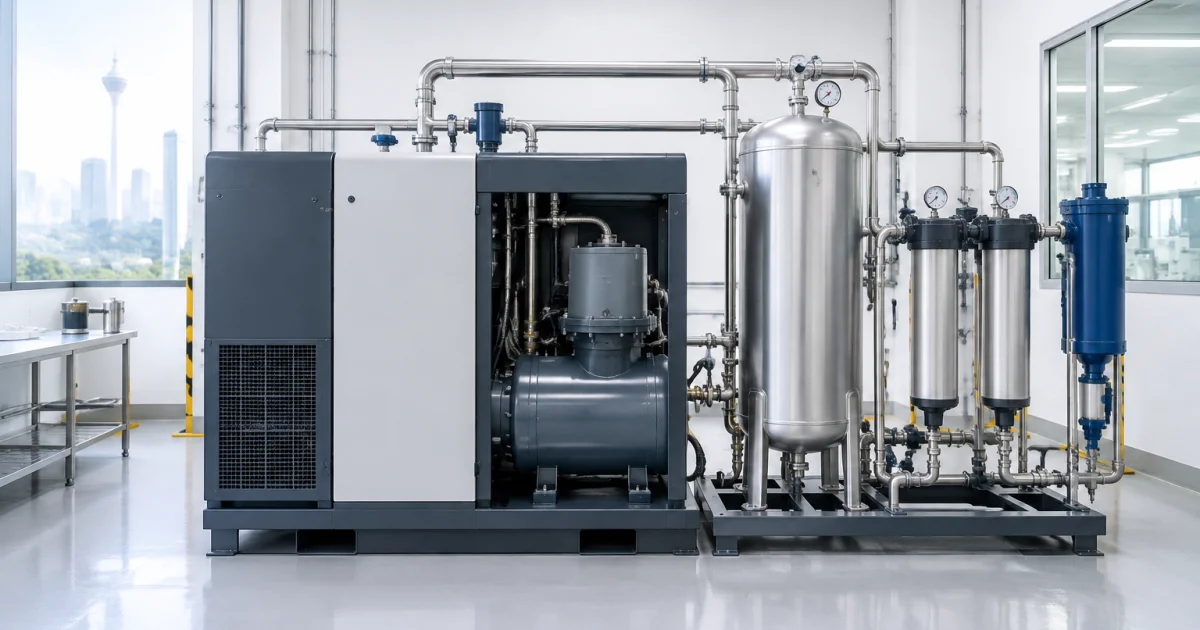
That’s why air treatment still matters: many sites need a dryer, a properly staged compressed air filter setup, and reliable condensate draining.
By contrast, oil-injected rotary screw compressors use oil for sealing, cooling, and lubrication. They’re widely used in industry for efficiency and durability, but typically require filtration to control oil aerosols/vapour in the air line.
When you really need an oil-free compressor in Penang
Choose oil-free when oil contamination could create safety, quality, regulatory, or costly rejection issues. Common “real need” scenarios include:
1) Air that can touch the product or product-contact surface
If compressed air can blow onto a product, enter packaging, or contact a product-contact surface, contamination risk rises (for example: air knives, blow-off, filling, sealing, packaging). Food-related production is the classic case, but similar expectations can apply in chemical, medical, and high-purity steps or when customer specs are strict. In these cases, oil-free plus correct drying and filtration is often the simplest risk-reduction path.
2) Laboratories and research equipment that is sensitive to contamination
Labs often use compressed air for instruments, actuators, and analytical equipment. Oil aerosols, odour, or moisture can affect test results and increase cleaning or maintenance. Oil-free is frequently a practical choice for repeatability—provided you also control dew point with the right dryer and filter sequence.
3) Electronics, optical, and precision manufacturing
Electronics assembly, PCB work, precision cleaning, and certain optical processes can be sensitive to mist, fine particulates, and moisture. Oil contamination can cause adhesion failures, defects, or rework. These environments benefit most from a complete clean-air approach: compressor choice, dryer selection, filtration, piping cleanliness, and disciplined maintenance.
4) Facilities with strict audit expectations or customer specs
Sometimes the decision is documentation-driven. If customers, QA, or auditors require oil-free for certain lines, treat it as a requirement—but ensure the rest of the system supports it (dryers, filters, monitoring, and service records).
When you don’t need oil-free (and what to do instead)
Many Penang sites choose oil-free for “better quality,” even when their applications don’t justify it. In these situations, an oil-injected system with proper air treatment and preventive maintenance is often more cost-effective.
1) Pneumatic tools and general workshop air
Workshops and general maintenance commonly use air for impact tools, blow guns, cylinder actuation, and plant air points. The biggest issues are usually water and pressure drop, not trace oil. A correctly sized rotary screw compressor, receiver (air tank), dryer, and filters typically delivers the performance you need.
2) Air used only for actuators, valves, and cylinders (non-contact)
If air never contacts product and is only used for motion/control, oil-free is often unnecessary. Prioritise stable pressure, dry air to reduce corrosion, and filtration to protect valves, regulators, and instruments.
3) You are trying to solve “wet air” by switching compressor type
Wet air is usually caused by humidity, inadequate drying, undersized piping, high inlet temperature, or poor condensate management. Switching to oil-free does not fix moisture by itself. If water is the issue, review the dryer, drains, receiver sizing, and distribution design first.
4) You need uptime and efficiency more than ultra-clean air
For many manufacturers, downtime is the biggest cost. A reliability-first Industrial Air Compressor Penang setup—correctly sized with strong service support—may matter more than compressor type. If demand fluctuates, a variable frequency (inverter-driven) screw compressor can reduce energy waste by matching output to real usage.
How to decide: a practical checklist (beginner-friendly)
Use this checklist before requesting a quotation to avoid overbuying or under-specifying.
A) Identify where the air goes (risk mapping)
- Direct contact with product/packaging? You likely need oil-free plus stronger filtration and drying.
- Indirect contact (blowing near open product)? Cleaner air may still be required due to aerosol drift.
- Non-contact (actuators/tools only)? Oil-injected is often acceptable with the right dryer and filters.
B) Define air quality needs in plain terms
Start with failure modes rather than labels:
- Will oil mist cause rejects, rework, or customer complaints?
- Will moisture cause corrosion, sticking valves, or instrument issues?
- Will particles damage nozzles, regulators, or sensitive equipment?
Then specify the combination of compressor type, dryer method, and filter grades to match those risks.
C) Consider operating hours and load profile
How long will the compressor run each day, and is demand steady or spiky? Continuous operations often suit rotary screw systems sized to avoid frequent cycling. Variable demand may justify a variable frequency screw compressor for better control and energy efficiency.
D) Don’t ignore the distribution system
System performance depends on the network. Check:
- Pipe sizing and routing to minimise pressure drop
- Receiver/air tank capacity to buffer demand spikes
- Drain points and automatic drains to remove condensate
- Dryer and filter placement to protect critical downstream equipment
E) Plan for maintenance and after-sales support
Compressed air isn’t “install and forget.” Filters need periodic replacement, drains must work reliably, and dryers require servicing. Ask what routine service includes, expected intervals, parts availability, and how breakdown support is handled—especially if air is production-critical.
System design that often matters more than “oil-free vs oil-injected”
In many installations, the biggest improvements come from the complete system: compressor, drying, filtration, condensate handling, distribution, and a service plan. When comparing quotations in Penang, evaluate the package—not just the compressor headline.
Dryers: why moisture control is non-negotiable
Malaysia’s humidity makes moisture management a constant requirement. A refrigerated dryer is a practical solution for many industrial uses, but it must be sized for flow, inlet temperature, ambient conditions, and operating pressure.
If you are evaluating a Friulair refrigerated air dryer, ensure correct installation, draining, and service access. An undersized or poorly installed dryer can cause persistent wet air even if the compressor is performing well.
Filters: protecting product and equipment
Filtration is where many systems succeed or fail. The right filtration train removes particles and coalesced aerosols and helps protect processes and equipment. If you’re searching for Compressed Air Filter Penang options, focus on:
- What you must remove (water droplets, aerosols, dust)
- Correct placement (before/after the dryer depending on purpose)
- Pressure drop and its effect on energy cost
- Element change intervals and maintenance practicality
As a practical next step, you can review the Air Care Filter page to see how filtration fits into an industrial compressed air line.
Oil-water separators: cleaner condensate handling
Dryers and compressors produce condensate, and in many systems it may contain oil residues (especially with oil-injected compressors). An oil-water separator helps manage condensate more responsibly. Compare capacity, compatibility with your condensate volume, and the service routine needed to keep it working.
Reliability planning: rental and temporary backup
If compressed air downtime stops production, plan a contingency. Some sites use rental or loan units during servicing or unexpected failures. See Air Compressor Rental Penang: A Solution For Industrial Air Compressor Needs for a practical overview.
Common beginner mistakes (and how to avoid them)
- Buying “oil-free” to fix wet air: solve moisture with drying, drains, and correct piping.
- Ignoring total cost of ownership: energy, pressure drop, service intervals, and downtime often matter more than purchase price.
- Undersizing the system: too small a compressor or receiver leads to unstable pressure and early wear.
- Overlooking maintenance access: poor layout makes filter/dryer service harder and increases neglect risk.
- Not documenting where clean air is required: you may only need oil-free on specific lines, not the whole plant.
Conclusion: choose based on risk, not marketing
Oil-free compressed air is the right solution when oil contamination is unacceptable—such as in contamination-sensitive production, certain labs, electronics/precision work, or when customer specifications demand it. For many general industrial uses in Penang, an oil-injected rotary screw compressor paired with the right dryer and filtration can deliver reliable performance and better cost efficiency.
Before deciding, map where air is used, identify the real risks (oil, water, particles), and evaluate the full system: compressor and receiver sizing, dryer selection, filters, condensate handling, piping, and service support. If you want to avoid over-specifying, speak with a supplier who can assess your application and recommend a practical configuration for your operating hours and quality needs.
For further reading on supplier comparisons, you may find this useful: Top Air Compressor Brands And Suppliers In Penang A Comprehensive Review.
Frequently Asked Questions
Is oil-free compressed air automatically clean enough for food and lab use?
Not automatically. Oil-free refers to the compressor’s compression method, but your air can still contain water, particles, and odours. Food-related production and laboratories typically still require correct drying (often a refrigerated dryer) and a properly selected filter train to control moisture and contaminants.
When is an oil-injected rotary screw compressor the better choice?
For many non-product-contact applications—such as pneumatic tools, cylinders, and general factory air—oil-injected rotary screw compressors can be a practical, efficient option. With the right air dryer, filtration, and maintenance, they can deliver stable pressure and reliable uptime without the higher upfront cost that sometimes comes with oil-free systems.
What air treatment equipment should I budget for with an oil-free compressor?
Most sites still need a dryer (commonly refrigerated) to manage humidity and condensate, plus filters to remove particles and protect downstream equipment. You may also need an oil-water separator for condensate handling, and adequate receiver (air tank) capacity to stabilise pressure during demand changes.
How do I choose the right compressed air filter setup in Penang?
Start by identifying what you must remove (water droplets, aerosols, dust) and where the air is used (product-contact vs general air). Then size filters to your flow rate and minimise pressure drop, and plan routine element changes. A supplier can recommend filter grades and placement relative to the dryer and critical equipment.
Do you supply Friulair refrigerated air dryers in Penang, and how do I size one?
Pneu-Care Resources Sdn Bhd supplies Friulair refrigerated air dryers as part of complete compressed air solutions. Sizing typically depends on your compressor flow, inlet air temperature, ambient temperature, and the pressure you run at. Providing these operating details helps ensure the dryer can consistently control moisture without being undersized.
Need help choosing oil-free vs oil-injected for your Penang site?
Pneu-Care Resources Sdn Bhd helps factories, labs, and manufacturers match the right compressor technology to real air-quality risk and operating demand. We supply rotary screw and variable frequency screw compressors, plus complete air treatment including Friulair refrigerated air dryers, Air Care filters, and BEKO oil-water separators—supported by servicing, maintenance, and rental/loan units for continuity.
Share your application (product-contact points, flow/pressure needs, operating hours, and current issues like wet air or pressure drop), and we’ll recommend a practical compressed air system configuration for your site.