

Penang Industry Update: New Environmental Expectations for Compressor Condensate Handling and What Factories Should Do Next
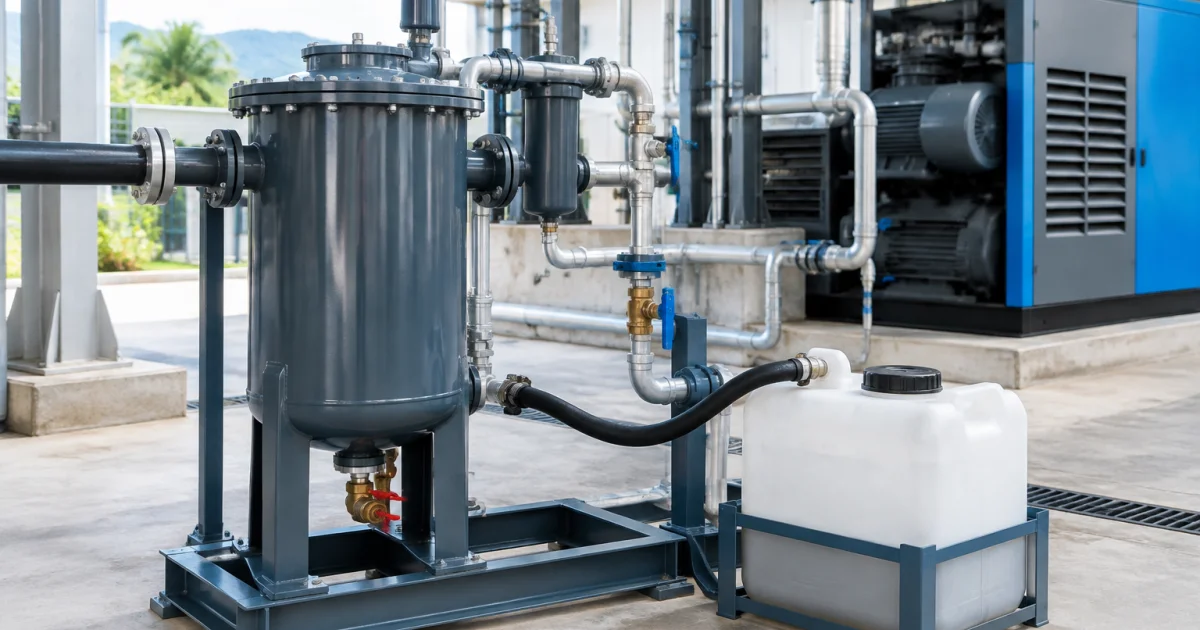
Across Penang’s industrial sites, compressor condensate is no longer treated as a minor housekeeping issue. EHS officers and maintenance teams are under increasing pressure to show condensate from compressed air systems is controlled—collected, treated, and disposed of intentionally rather than drained to floors, open gullies, or unknown discharge points.
This update is written for the people who run and maintain the systems a factory depends on: teams operating an Industrial Air Compressor Penang facility relies on, technicians maintaining dryers and drains, and EHS leads who must explain (to management and auditors) how condensate is managed.
Rather than guess specific regulations, this article translates “higher expectations” into practical control outcomes and a field-ready plan covering equipment, routing, operating routines, and documentation—so you can improve compliance and uptime together.
Why condensate handling is getting more attention in Penang plants
Compressed air systems naturally produce condensate when humidity is compressed and cooled into liquid water. In lubricated compressors, that liquid can also carry oil aerosols and contaminants picked up in the compressor and piping. By the time it reaches drains, it may contain oil, rust, dirt, and intake-borne contaminants—even when it looks clear.
Historically, many sites handled condensate informally (manual drains, hoses to a nearby gully, buckets). The problem is uncertainty: what’s in it, where it goes, and whether it can reach stormwater pathways. As environmental control expectations rise, uncertainty becomes a risk.
Condensate is also an operations issue. Poor drainage and moisture control contribute to wet air lines, corrosion, stuck pneumatics, premature filter loading, and unpredictable system behavior. Environmental control and reliability are linked: ad-hoc handling often leads to ad-hoc uptime.
What “new environmental expectations” usually mean in practice (without guessing rules)
Different customers, auditors, and internal ESG programs use different language, but expectations often converge on the same outcomes your site should be able to demonstrate.
Outcome 1: No uncontrolled discharge
Prevent condensate—especially oily condensate—from going to ground, open drains, or stormwater routes. Visual clarity is not proof of low contamination.
Outcome 2: Treatment is purposeful, not accidental
If you treat onsite with an oil-water separator, it must be correctly sized, installed, and maintained. If you do not treat onsite, you need a defined collection and offsite disposal route. Either way, the method must be repeatable and consistent.
Outcome 3: Traceability and simple records
Be able to show a basic diagram, checklists, maintenance logs, and disposal notes. It does not need to be bureaucratic; it needs to be credible and usable across shifts.
Outcome 4: A system approach across compressor, dryer, filters, and drains
Condensate control is rarely one component. Expectations extend to moisture removal (dryer), aerosol removal (filters), drain reliability (automatic drains), and management of collected liquid (separator or collection tank).
Where condensate comes from: mapping your system so you don’t miss drains
Many gaps come from underestimating how many condensate sources exist. Start by mapping every location where condensate can form and be discharged.
Typical condensate generation points include:
- Compressor package drains (design-dependent: aftercooler/separator area, etc.).
- Air receiver / compressor tank drain (often significant in humid conditions).
- Refrigerated dryer drain (commonly overlooked; may run frequently).
- Coalescing and particulate filters drain points.
- Drip legs and low points in distribution piping.
- Point-of-use filter regulators (if they include drainable bowls).
Practical step: walk the system, tag each drain point, and record whether it is manual or automatic, where it discharges, and whether it routes to a closed manifold. “Mystery hoses” disappearing into floors or open drains are priority gaps.
Immediate risk check: common condensate handling issues seen in factories
Before investing in new equipment, reduce risk quickly by checking for common failure points that drive both environmental exposure and production problems.
1) Manual drains used as the primary strategy
Manual draining depends on people remembering. Missed drains allow receivers to fill, leading to water carryover and occasional large discharges when someone finally opens a valve.
2) Timed drains set incorrectly
Timer drains can work, but poor settings waste compressed air (too long open) or leave water behind (too short). Many sites never revisit settings after installation, even when load profiles change.
3) Drains discharging to open floor drains
Open discharge creates splash, odor, and uncertainty. If you cannot clearly explain where it goes and how it is controlled, assume you will be asked to prove it.
4) Oil-water separator installed but not maintained
Separators are not “fit and forget.” Media saturates, flow paths block, and bypass can occur with poor installation. A neglected separator can create false confidence.
5) Missing or failed drains after filters and dryers
When housings retain condensate, pressure drop increases and water can be re-entrained. This accelerates corrosion and causes tool/instrument complaints.
6) No defined disposal route for collected waste
Collecting condensate in containers without clear responsibility, contractor route, and records simply relocates the risk to a different corner of the utility room.
What factories should do next: a practical condensate control plan
If you need to respond quickly to tightening expectations, use a short, structured plan that EHS and maintenance can execute together.
Step 1: Define your discharge philosophy (treat onsite vs. collect for disposal)
Two common pathways used in industrial practice are:
- Onsite treatment with an oil-water separator: Pipe condensate from multiple drains to a separator designed for compressor condensate. Retain the oil fraction for proper disposal; handle the treated water per site policy.
- Full collection and offsite disposal: Route condensate to closed containers and dispose via an approved waste contractor when onsite treatment is not feasible or policy requires offsite handling.
Choose based on volume, space, and internal EHS requirements. The key is consistency: every drain point follows the same controlled route.
Step 2: Standardize drain hardware at every condensate point
A fast, high-impact upgrade is replacing “someone opens a valve” with controlled automatic drainage. A strong baseline includes:
- Automatic condensate drains at the compressor package, receiver, dryer, and filters.
- Isolation valves and service-friendly piping so drains can be maintained without shutting down the entire line.
- Clear discharge routing from each drain into a closed manifold or collection line.
If your team is searching for Condensate Drain Penang solutions, convert the search into a site standard: pick one drain type for most points, keep spares, and document settings and service intervals.
If you are evaluating timer-based drainage, review a purpose-built option such as the Condensate Timer Drain page to align features, service needs, and operating realities.
Step 3: Build a closed condensate manifold (so nothing “mysteriously” goes to a drain)
A condensate manifold is simple piping that gathers discharge from multiple drain points and routes it to a single controlled destination (separator or collection tank). It reduces hoses, buckets, and ad-hoc routing while making the flow path easy to explain during reviews or audits.
To make a manifold reliable:
- Size piping for peak drainage to avoid backpressure (backpressure can cause drains to leak air or fail to open).
- Keep runs short; minimize unnecessary elbows where sludge can settle.
- Provide a low-point inspection/flush point.
- Label lines so technicians immediately recognize “condensate.”
Step 4: Add separation where lubricated compressors are used
Lubricated rotary screw compressors can generate oily condensate. A standard control is an oil-water separator designed for compressor condensate (for example, BEKO systems) to separate oil content from the water stream so each can be handled appropriately.
If you have multiple compressor rooms or multiple lines, you may need multiple separators or a central unit sized for combined flow. Undersizing is a common problem: it may appear fine at average conditions but struggle at high humidity, high load, or when several drains dump simultaneously (often after a shift start).
Selection should consider compressor capacity, operating hours, and expected condensate volume. When uncertain, involve a vendor who can review your layout and load profile rather than estimating from motor kW alone.
Step 5: Reduce condensate generation by treating the air properly
Condensate control is not only about collecting liquid; it is also about preventing downstream condensation. Two components strongly influence this:
- Refrigerated dryers: Proper sizing and maintenance reduces moisture formation in downstream piping. Friulair refrigerated air dryers are a common industrial choice for continuous duty when serviced correctly.
- Filtration: Appropriate filtration (especially coalescing stages) reduces oil aerosols and particulates, improving air quality and helping downstream equipment. Filters also need functional drains and should be included in the condensate plan.
The operational payoff is often immediate: fewer sticking valves, fewer wet-air complaints, reduced corrosion-related leaks, and more stable tools and instruments—benefits that also strengthen the environmental case.
For internal discussions on filtration stages and maintenance expectations, the Air Care Filter page can be a useful reference.
Step 6: Document the system in a way your site can maintain
You do not need a thick binder; you need documentation that survives shift work and staff rotation. A simple “condensate control pack” can include:
- One-page schematic showing compressor(s), receiver, dryer, filters, drain points, manifold, separator/collection tank, and disposal route.
- Drain point register: asset tag, location, drain type, timer settings (if used), and maintenance frequency.
- Separator maintenance log: inspections, media replacement dates, and issues found.
- Disposal notes: when oil fraction/collected waste is removed and by whom (per site process).
This provides credible evidence of control and makes troubleshooting faster by pinpointing which drain point or component is creating water carryover.
Practical examples: what “good” looks like in real plant scenarios
These examples illustrate how to structure decisions and installations. They are not compliance guarantees for every site, but they reflect practical, auditable approaches.
Example A: Single compressor + receiver tank + refrigerated dryer
Situation: One rotary screw compressor feeding one main line. Manual receiver drain. Dryer drain discharges to a floor drain.
Upgrade path:
- Install automatic drains at the compressor, receiver, and dryer.
- Route all drains to a small manifold leading to a closed collection container or an oil-water separator (based on compressor type and site policy).
- Use a short daily checklist: leaks, drain status, container level/separator status.
Benefit: Less water carryover, fewer wet-air issues, and a clear, auditable condensate route.
Example B: Multiple compressors with alternating duty and varying load
Situation: Two or three compressors switching duty. Condensate varies by shift. Timer drains were set years ago.
Upgrade path:
- Audit timer settings based on observed condensate and air loss; adjust intervals and open time.
- Connect each compressor package drain to a common closed manifold.
- Size the separator for peak combined condensate, not average conditions.
- Keep drain spares and define a response plan for stuck-open or stuck-closed drains.
Benefit: Less air waste, fewer pooling incidents, and fewer water-related pressure drop and contamination events.
Example C: Sensitive application areas considering oil-free air
Situation: A lab, packaging line, or process area is concerned about oil contamination while the utility room still has condensate risk.
Upgrade path:
- Assess whether oil-free compression is required, or whether separation and point-of-use filtration can meet internal quality targets.
- Maintain disciplined condensate routing regardless of compressor type; water still forms and must be controlled.
- Verify dryer performance to reduce moisture-related instrument issues.
Benefit: Air quality strategy aligned with application risk, while maintaining robust condensate control in the compressor room. Background reading on Oil Free Air Compressors can help frame where oil-free matters most and what still needs attention downstream.
Supplier support checklist: what to ask before you buy or retrofit
Condensate projects often involve drains, manifolds, dryers, filters, separation, and ongoing service. When selecting a partner in Penang, focus on support capabilities—not just parts supply.
Can you support a system review, not just a single part?
Many problems come from interactions (dryer not draining, blocked filter drain, poor routing). A supplier who can review the whole system helps avoid “fix one point, create another issue.”
Do you provide after-sales servicing and preventive maintenance?
Consistency matters. Ask how drains are tested, how separators are maintained, and how inspections are scheduled. If you have in-house technicians, clarify responsibilities: what your team handles versus what the supplier supports.
To benchmark the broader market, a neutral overview like Top Air Compressor Brands And Suppliers In Penang can help, then narrow the shortlist to partners who can support condensate end-to-end.
What happens if a compressor goes down during retrofits?
Downtime concerns often delay improvements. If production cannot stop, ask about temporary compressor support during installation or major service events. Rental or loan units can keep air supply running while drains, piping, dryers, or filters are upgraded.
For continuity planning, review options like air compressor rental support when upgrades must be executed without stopping operations.
Will you help create a simple documentation pack?
Ask for commissioning notes, recommended service intervals, and a basic schematic. Documentation is often the difference between a good installation and a sustainable program.
Maintenance routines that keep you aligned (and reduce surprises)
Long-term control comes down to simple routines. The best condensate system is easy to check and hard to ignore.
Daily / shift checks (5–10 minutes)
- Check for leaks at drain outlets and manifold joints.
- Confirm no drain is stuck open (continuous hissing indicates air loss).
- Verify collection container level or separator status (if applicable).
- Look for unexplained wet patches near equipment.
Weekly checks
- Test drain function at critical points (receiver, dryer, main filters).
- Inspect any strainers/screens used by your drain type.
- Confirm dryer performance remains stable.
Monthly / quarterly checks (depending on duty cycle)
- Inspect separator condition and replace media per manufacturer guidance and observed loading.
- Review filter differential pressure trends for signs of water/oil loading.
- Track repeat drain issues and plan upgrades or rerouting where needed.
Design principle: if a routine requires special tools or a shutdown, it will eventually be skipped. Build the system to be service-friendly.
Conclusion: turn “expectations” into a controllable system
When Penang factories hear that expectations for compressor condensate handling are rising, the most effective response is not panic or piecemeal fixes. Build a controllable system: identify every condensate source, standardize drains, route discharge through closed piping, treat or collect it intentionally, and keep simple records that show control.
Done well, condensate management also improves reliability: drier air, less corrosion, fewer tool problems, and fewer surprises in the utility area. For EHS and maintenance teams, reduced environmental risk and improved uptime is usually the strongest case for acting now.
Frequently Asked Questions
What is compressor condensate, and why is it considered an environmental risk?
Compressor condensate is liquid formed when humid air is compressed and cooled in a compressed air system. In lubricated compressors, it can contain oil aerosols and contaminants, so uncontrolled discharge to floors or drains can create environmental and housekeeping risks. A controlled route (collection and treatment or offsite disposal) reduces uncertainty and exposure.
Where should we install condensate drains in a factory compressed air system?
At minimum, install functional drains at the compressor package, the air receiver (compressor tank), the refrigerated dryer, and the main filters. Also review low points in distribution piping and drip legs. The goal is to ensure every condensate source has a defined drain point and a controlled discharge route.
Do we need an oil-water separator for our condensate in Penang?
If your system uses lubricated compressors, an oil-water separator is a common industrial method to separate oil content from the condensate water stream. If you cannot treat onsite, you can collect condensate in closed containers and manage disposal through your site’s approved process. The right option depends on volume, space, and internal EHS requirements.
How can we reduce the amount of condensate downstream of the compressor?
Improve air treatment. A properly sized and maintained refrigerated air dryer reduces moisture condensation in downstream piping, while appropriate filtration helps remove oil aerosols and particulates. Reducing water carryover also lowers corrosion risk and helps pneumatic tools and instruments run more consistently.
What should we look for in a compressor service provider to support condensate compliance?
Look for a provider that can review the entire compressed air system (compressor, dryer, filters, drains, and routing), supply appropriate drains and separation equipment, and support preventive maintenance. Practical help with commissioning, troubleshooting, and basic documentation is also valuable—especially when EHS teams need clear evidence of control.
Get condensate handling support that protects uptime and reduces risk
Pneu-Care Resources Sdn Bhd helps Penang factories move from ad-hoc draining to a controlled condensate management setup—combining compressors, Friulair refrigerated dryers, Air Care filters, BEKO oil-water separators, and practical servicing support.
If your EHS team needs a clearer condensate route, or your maintenance team is dealing with wet air, leaking drains, or unclear disposal practices, we can help you review your system, recommend suitable equipment, and plan service-friendly improvements that fit your operating hours.