

Is Air Compressor Rental the Smarter Choice for Penang Factories Facing Unplanned Downtime?
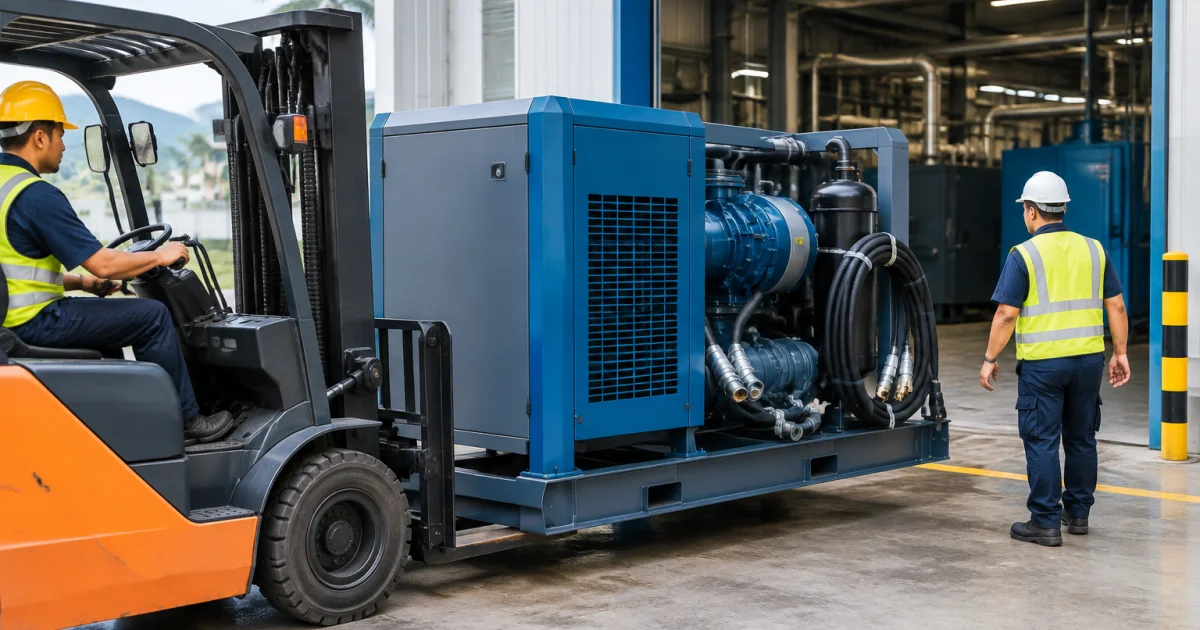
In many Penang factories, compressed air is so embedded in daily operations that it only gets noticed when it disappears. A sudden trip, failing airend, motor issue, or major leak can quickly cascade into missed output, quality problems, and a maintenance team scrambling to keep lines running.
This article takes a clear view: during unplanned downtime, rental is often the smartest “bridge” decision—not because it is always cheaper, but because it can restore stable compressed air fast while you make a calmer long-term choice (repair, replace, resize, or redesign).
Rental is not automatically best. Sometimes a fast repair, switching to a backup unit, or an immediate purchase is the right move. The goal is to help Penang operations and maintenance teams decide with fewer assumptions and more practical checks.
Why unplanned downtime turns “compressor decisions” into risk decisions
In normal conditions, compressor choices are engineering choices: capacity, pressure, efficiency, space, and lifecycle cost. During an outage, they become risk choices: how quickly air returns, what air quality is acceptable for the next shift, and what compromises might trigger safety or production risk.
Rental often wins because it separates two timelines:
- Timeline A: restore air supply (hours to a day)
- Timeline B: decide and execute the best permanent fix (days to weeks)
When those timelines get forced into one rushed decision, factories tend to overbuy, under-specify air treatment, or accept unstable pressure just to “get by.” A planned rental window reduces these compromises.
Common operational impacts of compressor failure include:
- Pneumatic cylinders, pick-and-place, and valves failing to cycle reliably
- More scrap due to inconsistent pressure or wet air
- Packaging issues (sealing, blowing, vacuum, labeling)
- Higher energy use if undersized portable units run continuously
- Maintenance focus pulled away from other critical assets
So the real question is not only “Is renting cheaper?” but “Is renting the fastest way to stabilize operations now without locking us into a hasty long-term decision?”
Rent vs repair vs buy: a decision lens that works on the factory floor
When a compressor fails, teams often default to what they did last time. A more reliable approach is to decide based on constraints: time, technical uncertainty, and air-quality requirements.
Choose rental when speed and certainty matter most
Rental tends to be the smarter choice when:
- The failure cause isn’t confirmed (electrical, controls, cooling, contamination, airend)
- Repair lead time is uncertain (parts availability, workshop queue, specialist support)
- You can’t afford repeat trips—a “reset and run” may fail again under load
- You need temporary capacity to catch up after shutdown or cover a short-run spike
- You’re already planning a replacement, but procurement/installation needs time
In these situations, Air Compressor Rental Penang acts like operational insurance: buy time to investigate properly, avoid rushed purchases, and keep the plant stable.
Choose repair-first when the fault is clear and repair is truly fast
A repair-first strategy can be best when:
- The fault is clear (e.g., contactor, sensor, solenoid, belt, minor leak) and parts are readily available
- You have redundancy (another compressor, enough receiver volume, or a secondary line)
- Your air-quality requirements are strict and you cannot risk a temporary setup without full treatment control
Even then, consider standby rental if the repair is “simple but uncertain.” Many plants have seen a quick fix become a second failure overnight.
Choose buy-now when the unit is end-of-life and the solution is obvious
Immediate purchase can be rational when:
- The compressor is clearly end-of-life and downtime is already recurring
- Capacity demand is stable and sizing is confirmed
- Installation readiness is high (space, ventilation, electrical, piping, drainage, condensate handling)
During emergencies, many factories cannot meet all these conditions. That’s why rental often becomes the bridge: rent now, buy correctly later.
What “good rental” looks like in an industrial Penang environment
Industrial rental should be more disciplined than “a mobile unit that blows air.” A good deployment aims to replicate the essentials of your system: capacity, pressure stability, and air quality appropriate for your process.
From an operations standpoint, a rental setup is “good” if it delivers:
- Fast mobilization with clear site requirements and safe hookup
- Stable pressure under real load, not only at idle
- Air quality managed (moisture, oil carryover, particulate) to an acceptable level
- Clear responsibilities: who monitors, drains, checks alarms, logs run hours
- An exit plan: what must be completed before off-hire (commission new unit, overhaul complete, air-quality checks)
In Penang’s climate, moisture is often the first hidden problem. Wet air can corrode lines, damage tools, and cause product issues. Treat rental as a temporary system, not just a compressor.
Sizing a rental compressor: avoid the two most expensive mistakes
Two costly errors are common: undersizing (pressure collapses, quality issues) and oversizing (wasted rental/energy, potential short-cycling if controls are poor).
You do not need perfect data, but you do need a structured method.
Mistake 1: sizing by nameplate only
Using the failed unit’s kW/HP alone is not enough. Delivered flow depends on model, condition, pressure setpoint, and control mode. Plants also expand, so the old unit may have been barely coping.
Mistake 2: ignoring system losses and “recovery” load
After downtime, demand often spikes: overtime shifts, restarting multiple lines, and extra air for cleaning or purging. That short recovery period can exceed normal demand.
Practical ways to estimate required flow quickly:
- Review trend logs from controllers/SCADA for flow and pressure
- Check receiver pressure decay during a controlled test to estimate leakage/base load
- List critical air consumers and decide what must run vs what can wait
- Observe pressure at the farthest drop during peak demand to reveal distribution limits
If you take one sizing principle: rent for stability, not for hope. A rental that “almost keeps up” is often worse than temporarily shutting one non-critical line and stabilizing the rest.
Air quality during rental: dryers, filters, and why “temporary” can still ruin product
Restoring pressure and flow is urgent, but air quality is the silent risk. If your process is sensitive—spraying, instrumentation, packaging, lab air, or certain chemical/process applications—wet or contaminated air can create defects without obvious compressor alarms.
Key air-quality elements to consider:
Moisture control (refrigerated air dryers)
In humid environments, condensation in lines causes downstream trouble. A refrigerated dryer (such as a Friulair unit) is often critical if your plant relies on dry air. Ask rental providers whether a properly sized dryer is available and what dew point performance to expect under load.
Particulate and oil control (compressed air filters)
Filters protect tools, valves, and product-facing equipment. Ensure filtration matches your sensitivity:
- Particulate filtration to reduce dust-related sticking and protect components
- Coalescing filtration to reduce oil aerosol and fine mist carryover
If you already have inline filters, check their condition. A clogged filter can create pressure drop that looks like an undersized compressor.
Condensate handling (oil-water separators)
Condensate management matters even short term. A temporary compressor can generate significant condensate, especially with frequent load/unload. An oil-water separator (such as a BEKO unit) helps keep housekeeping manageable and supports cleaner handling around the rental area.
A single well-treated temporary system is usually easier to control than multiple small portable units scattered around the plant.
Practical downtime scenarios: when rental is (and isn’t) the smarter choice
These scenarios reflect common decision patterns during real incidents.
Scenario A: the main screw compressor trips repeatedly and won’t hold load
Common reaction: keep resetting, reduce pressure, hope it survives the shift.
Risk: repeated trips can indicate cooling failure, motor overload, control faults, or airend issues. Pushing it can convert a recoverable problem into a major failure.
Smarter move: mobilize rental to stabilize production, then troubleshoot without production pressure (ventilation, oil cooler condition, inlet valve behavior, supply quality, controls/calibration).
Scenario B: you need air during a scheduled overhaul, but production can’t stop
Common reaction: postpone overhaul.
Cost of postponing: preventive work gets skipped, and unplanned stoppages later become more likely (often at the worst time).
Smarter move: rent for the overhaul window. This converts a risky delay into a planned activity.
Scenario C: you suspect the plant is undersized, but you’re not sure
Common reaction: buy bigger “to be safe.”
Why it can backfire: oversizing can create inefficiency, short cycling, and poor part-load performance if controls are mismatched. It can also hide leaks because there is always “enough air.”
Smarter move: rent higher capacity temporarily and observe real demand and pressure stability. Use the rental period to validate sizing before committing capital.
Scenario D: a small piston unit is suggested as a quick backup
When it can work: small workshop areas, short low-sensitivity tool runs, or non-critical utility air where noise and pressure variation are acceptable.
When it usually fails: continuous industrial loads. Many factories need an industrial rotary screw solution for duty cycle, stable airflow, and integration with air treatment.
“Any compressor is better than none” is not always true—sometimes it adds quality risk and makes troubleshooting harder.
Hidden costs and hidden benefits of renting (beyond the rental invoice)
The main value of renting during downtime is operational control, not just invoice comparison. But the trade-offs are real.
Hidden costs to watch
- Site readiness work: temporary piping/hoses, couplings, isolation valves, safe routing
- Power compatibility: cable sizing, breaker capacity, electrical safety checks
- Pressure-drop surprises: long hose runs, undersized fittings, clogged filters, poor layout
- Quality omissions: skipping dryer/filters can lead to scrap, rework, or tool failures
- Condensate management: without a plan, housekeeping and environmental risk rises
Hidden benefits that often outweigh cost differences
- Faster restart with less production chaos
- Better troubleshooting because the failed machine can be isolated and tested offline
- Procurement breathing room to select the right permanent package
- Short-term redundancy while you address leaks or distribution constraints
If your factory has been evaluating an Industrial Air Compressor Penang solution, a properly specified rental period can also function as a practical trial of capacity and control strategy.
How to execute a rental deployment smoothly: a step-by-step checklist
Rental is only “smarter” if deployment is disciplined. Use this checklist to reduce avoidable mistakes in urgent situations.
Step 1: define the minimum operating requirement
- Which lines/processes must run in the next 4–12 hours?
- Required pressure at the point of use (not only at compressor discharge)
- Critical air-quality needs (dry air for instruments, clean air for spraying, etc.)
Step 2: confirm connection points and distribution constraints
- Where can you tie in safely? (main header, receiver inlet, dedicated manifold)
- Is there isolation and a backflow-prevention approach?
- Is the receiver (air tank) usable, or part of the problem?
Receiver volume helps smooth demand spikes, but a neglected tank can also be a contamination or leak source. If you suspect a compressor tank leak or severe internal corrosion, isolate it until checked.
Step 3: specify the temporary system, not just the compressor
- Compressor type and capacity suitable for duty cycle
- Dryer requirement (often refrigerated dryer for industrial lines)
- Filtration stages appropriate to your process
- Condensate drainage method and where condensate will be handled
Step 4: plan monitoring and responsibility
- Who checks pressure and temperature each shift?
- Who checks drains and differential pressure across filters?
- What alarms or trip conditions require immediate escalation?
Step 5: use the rental window to fix the root cause (and improve the system)
Rental becomes a recurring habit if you do not use the time well. During the rental period, prioritize:
- Root-cause analysis of the original compressor failure
- Leak inspection and quick repairs on major distribution leaks
- Verification of pressure setpoints (many plants run higher pressure than needed)
- Review of dryer and filtration condition to prevent recurring quality issues
This is also a good time to reassess whether your broader setup of Air Compressors Penang sites commonly install—compressor, dryer, filters, condensate treatment—matches your operational risk tolerance.
Choosing the right rental partner in Penang: what to ask (and what to avoid)
Not all rental offerings are equal. Some are convenience-first; others are designed for industrial continuity. Under pressure, having a short question list helps.
Questions that reveal capability
- What capacity range and control modes are available? Matching fluctuating demand improves stability
- Can you provide air treatment with the rental? Dryer and filters, not only the compressor
- What does mobilization and commissioning include? Site check, safe hookup, under-load verification
- Do you support troubleshooting while rental runs? Helps shorten the rental period
- Do you offer temporary loan units during repair windows? Useful for repair-first plans
Red flags to take seriously
- Vague answers about air quality, condensate, or filtration
- No interest in point-of-use pressure requirements or critical processes
- “Just rent the biggest unit” with no discussion of distribution limits and real demand
- No plan for safe hose routing, isolation, or basic commissioning checks
Even in an emergency, insist on the basics: correct sizing, safe integration, and air quality that will not create secondary problems.
Conclusion: when rental is the smarter choice—and how to make it pay off
Is rental the smarter choice for Penang factories facing unplanned downtime? In many cases, yes—when your immediate objective is to restore stable compressed air quickly while protecting your ability to make a sound permanent decision.
Rental is especially useful when the failure cause is uncertain, repair lead times are unclear, or replacement is likely but needs time. The best outcomes come when factories treat rental as a temporary compressed air system—compressor plus dryer/filters/condensate plan—rather than a quick machine drop-off.
The practical takeaway: use rental to buy time, then use that time well. Stabilize production, diagnose the root cause, validate capacity, fix leaks, and then decide whether repair or replacement is the best long-term path.
Useful next reads
- Air compressor rental in Penang for industrial continuity
- When oil-free compressed air is the better fit
- Repair services for compressor troubleshooting and recovery
- Air Care Filter options for compressed air filtration
Frequently Asked Questions
How fast can an industrial air compressor rental be deployed to a Penang factory during an emergency?
Deployment speed depends on unit availability, site access, and how quickly a safe tie-in point and power connection can be prepared. In practice, the fastest deployments happen when the factory can confirm required pressure/flow, provide a clear loading or service entrance, and identify where the temporary compressor, dryer, and hoses will be placed and routed.
What information should I prepare before requesting Air Compressor Rental Penang support?
Prepare (1) required operating pressure at the point of use, (2) the estimated airflow or the size of the failed compressor and how many lines must run, (3) operating hours/duty cycle, (4) power availability, (5) whether your process needs dry air or cleaner air (dryer/filters), and (6) preferred connection point to the main header or receiver. Even rough information helps prevent undersizing and unstable pressure.
Do I need a refrigerated air dryer and filters for a temporary rental setup?
Often yes. Even for short-term use, moisture and contaminants can cause tool failures, valve sticking, corrosion, and product defects. If your plant normally relies on treated compressed air, a rental package should typically include appropriate filtration and (where needed) a refrigerated dryer such as a Friulair unit to manage moisture in humid conditions.
Can rental help if we’re not sure whether to repair or replace our compressor?
Yes. Rental is commonly used as a bridge: it restores air supply quickly while giving your team time to diagnose the fault properly, check parts lead times, and compare repair versus replacement options without production pressure. The key is to use the rental window to complete root-cause analysis and confirm correct long-term sizing.
How should we handle condensate from a rental compressor in an industrial plant?
Plan condensate drainage and collection from day one. Condensate volume can be significant, especially during frequent load/unload cycles, and it may contain oil. Many industrial sites use an oil-water separator (for example, a BEKO system) as part of good housekeeping and cleaner condensate handling during both temporary and permanent compressor operation.
Need temporary compressed air fast—without risking product quality?
Pneu-Care Resources Sdn Bhd supports Penang operations teams with compressor rental and loan units, plus the practical system components that make temporary air stable—dryers, filters, and condensate handling support. If you’re facing an unplanned shutdown or planning an overhaul window, we can help you size the right temporary setup and keep production moving while you decide whether to repair or replace.